On-chain Finance Network Initiative Unveiled at Vietnam FinTech & RegTech Immersion Program 2026 - Marking a New Chapter for Southeast Asia's Digital Economy

A proof-of-concept milestone demonstrating that a compliant, interoperable on-chain economy between sovereign jurisdictions is technically achievable — with Vietnam and Indonesia as the first participating nations.
VIFC-HCMC, Ho Chi Minh City — GOE Alliance (Global On-chain Economy Alliance) today introduced the On-chain Finance Network (“OFN”) — a technology initiative proposing a new class of regulated, interoperable infrastructure for digital assets — at the Vietnam Fintech & RegTech Immersion Program 2026, co-organized by Austrade and VIFC-HCMC and held at the VIFC-HCMC Building, Ho Chi Minh City. In a landmark proof-of-concept demonstration, a cross-border on-chain transaction was successfully executed between a KYC-verified citizen of Vietnam and a KYC-verified citizen of Indonesia, conducted under a formal multi-party exploration framework signed by GOE Alliance, Sky Mavis, PILA, and TOTM Technologies.
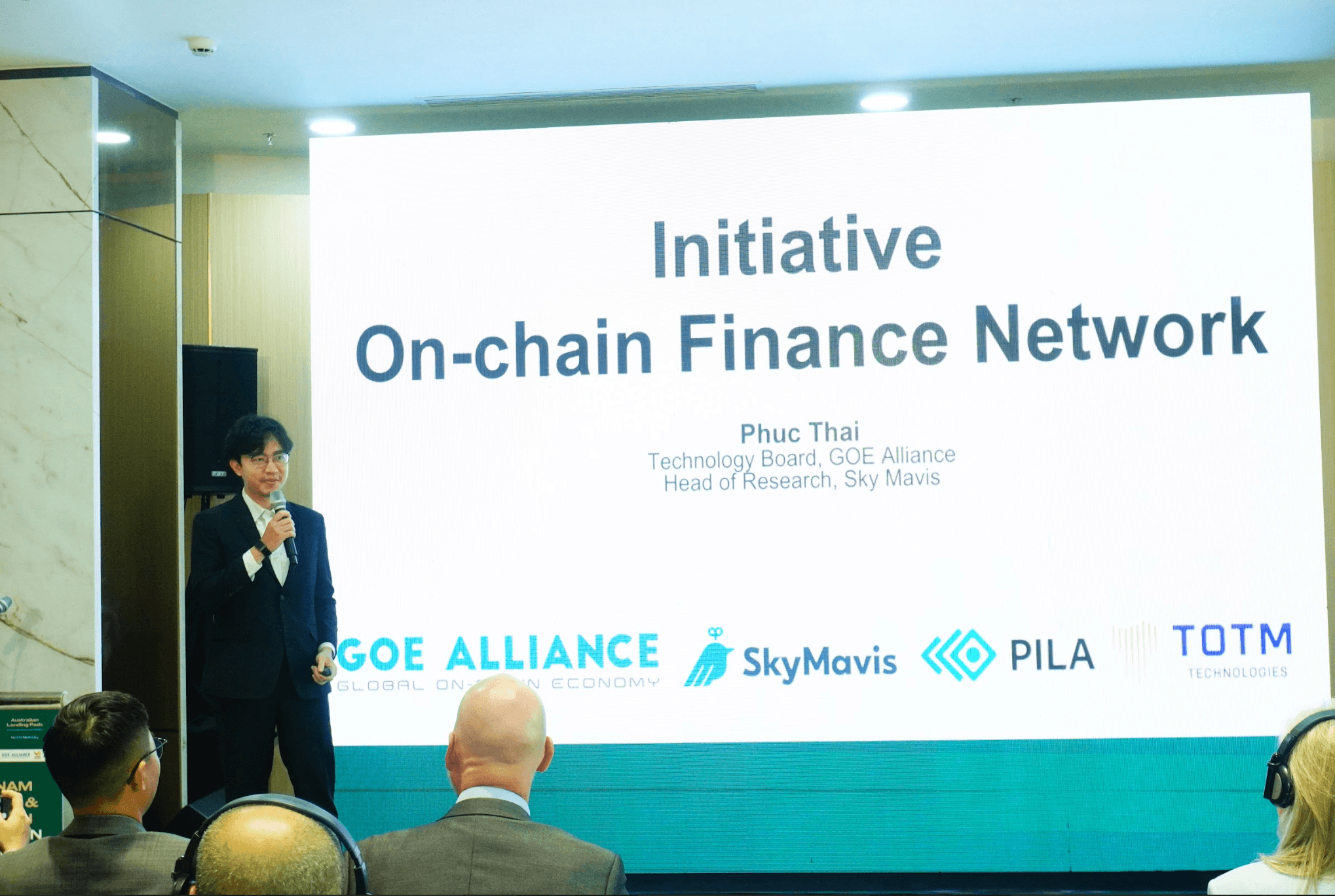
The first phase demonstration marks one of the first technical validation of its kind in Southeast Asia: proof that identity verification systems from two sovereign states can be interlinked to enable a fully KYCed on-chain transaction — without transferring any raw personal data across borders.
OFN remains at this stage an exploratory technology initiative, not yet a deployed network. What today's milestone establishes is something more foundational: the technical feasibility of the concept itself, which set the bedrock for future phases such as operational, regulatory, legal alignment.
The Problem OFN Is Designed to Solve
Blockchain technology has long promised to make capital flows frictionless, instant, and borderless. That promise has largely gone unfulfilled at the institutional level — not because the technology is inadequate, but because the cross-border aligned compliance layer has been missing.
Today, if a Vietnamese business wants to transact on-chain with an Indonesian counterpart, both parties face a hard barrier: their KYC and KYB verifications — completed at significant cost under their respective national laws — are invisible to each other's regulatory environment. The result is duplicated compliance costs, legal uncertainty, and capital that cannot move freely even when the underlying technology could support it in milliseconds.
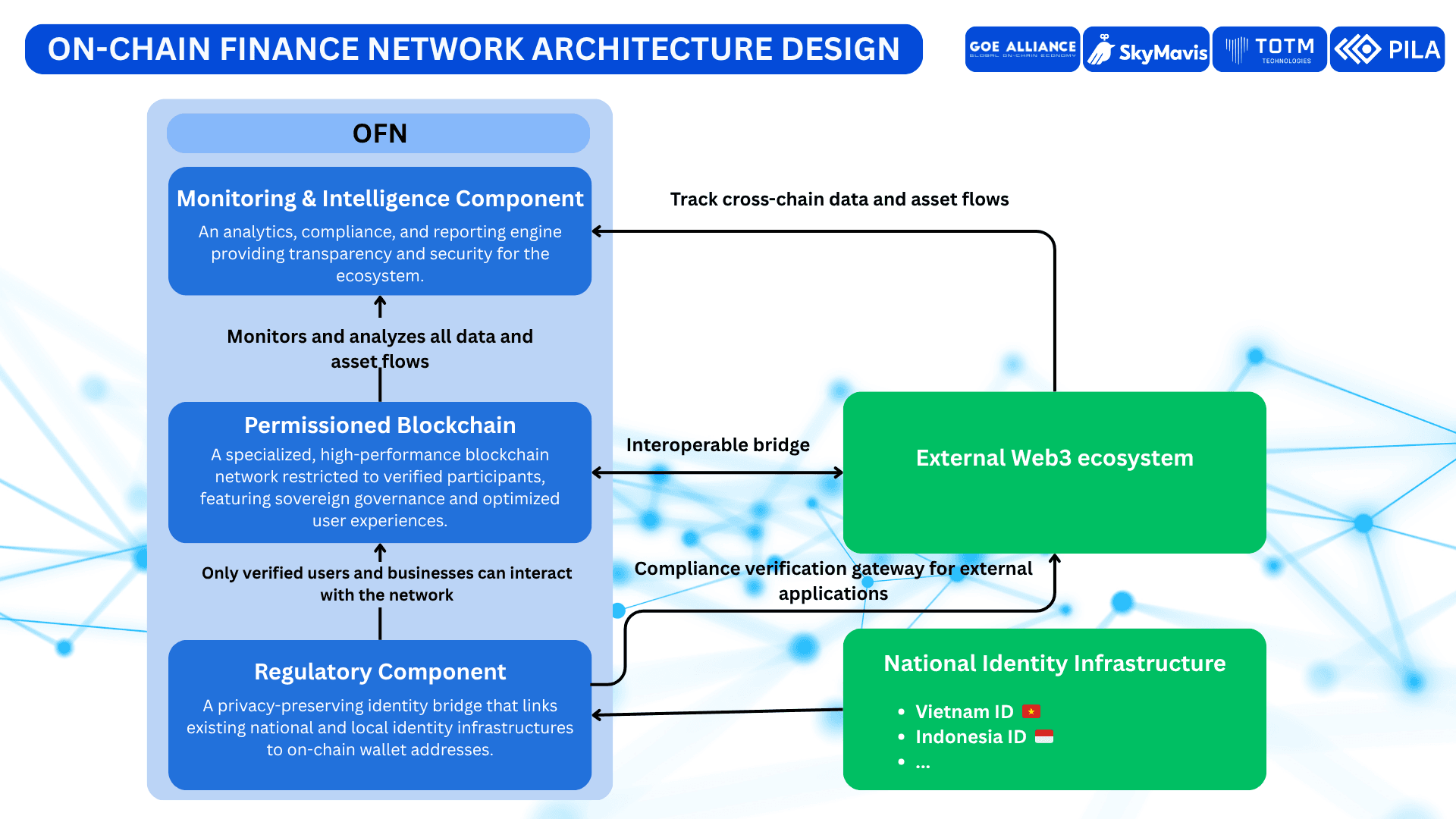
OFN addresses this directly. It builds a connectivity layer between nationally compliant identity systems, allowing verified credentials — not personal data — to be mutually recognized across borders. When a business completes KYB in Vietnam, that verification is converted into a privacy-preserving digital credential that can be recognized by the Indonesian authority side of a transaction. Business transactions between two verified parties can be conducted. The regulators of both nations retain full visibility. The cost of compliance is incurred once, not twice.
A $16 Trillion Opportunity
The stakes are significant. Leading global institutions — from the Bank for International Settlements to the World Economic Forum — project that by 2030, up to 10% of global GDP, approximately $16 trillion in value, will be tokenized and operating on-chain. Institutional tokenization programs such as Project Guardian (MAS) and the wave of stablecoin legislation advancing through the US, EU, Japan, and across Southeast Asia signal that this transition is structural, not cyclical.
At the center of this transition is an unsolved problem: how do sovereign regulatory systems, each with their own identity verification standards, interoperate in a digital asset economy that does not respect borders? OFN is a direct answer to that question.
A functional OFN — connecting jurisdictions that have already begun legislating digital assets — has the opportunity to align the conditions for institutional capital to move on-chain across borders at scale: with the efficiency of DeFi and the legal certainty of traditional finance.
What This Means for Vietnam and Indonesia
Vietnam and Indonesia are not incidental choices — they are the ideal first corridor for OFN. Bilateral trade between the two countries hit a record $17.2 billion in 2025, nearly doubling from $8 billion in 2020, yet the majority of this flow still clears through correspondent banking chains that can cost over 6% per transaction and take several days to settle. At the same time, both economies are digitizing at speed: Vietnam's digital economy is projected to reach between $90–200 billion by 2030, growing at a CAGR of 19%, while Indonesia's is forecast to reach $220–360 billion over the same period. OFN targets the gap between these two trajectories — the point where high-growth digital economies collide with compliance infrastructure that has not kept pace. By enabling a Vietnamese business verified under compliant framework to transact on-chain with an Indonesian counterpart verified through TOTM's national biometric ID system — with no duplication of KYC/KYB processes and no transfer of raw personal data — OFN converts a $17 billion bilateral trade relationship into a live testbed for the infrastructure that could underpin a combined $500+ billion digital economy corridor by 2030.
Beyond the two pilot nations, OFN is designed to be extensible. Each new jurisdiction that legislates digital assets and joins the network multiplies the value for all existing participants — a network effect that mirrors, and potentially surpasses, the one that made SWIFT the backbone of global finance.
The Initiative: Four Parties, One Framework
To formalize the exploration, GOE Alliance, Sky Mavis, PILA, and TOTM Technologies have executed a Memorandum of Understanding for the Collaborative Exploration of Cross-Jurisdictional Compliant On-chain Transaction Infrastructure.
Each party contributes a distinct and critical capability:
GOE Alliance — Initiating Party and project coordinator, responsible for coordinating the technical exploration, facilitating communications among the Parties, and ensuring alignment with global compliance principles and the VIFC-HCMC policy environment.
Sky Mavis — Contributes blockchain infrastructure expertise to the design and testing of the technical architecture for compliant cross-jurisdictional on-chain transactions.
PILA — Contributes its digital identity management solution for Vietnamese participants, supporting the issuance, management, and verification of on-chain identity credentials.
TOTM Technologies — Contributes its multimodal biometric national ID system and identity verification platform to provide KYC/KYB authentication services for Indonesian participants.
The MOU is strictly exploratory in nature. It does not establish a joint entity, commercial product, or deployed network. Any such development will be the subject of separate definitive agreements. What it does establish is a shared commitment to answering the foundational technical and regulatory questions — rigorously, and in the open.
"What we demonstrated today is not a pilot program or a whitepaper. It is a working proof that the compliance layer for a cross-border on-chain economy can be built — and that Vietnam, through VIFC-HCMC, is the right place to build it. OFN, once fully realized, could become the infrastructure backbone for on-chain capital flows across Southeast Asia and beyond."
— PhD. Tony Tran, Executive Board, R&D Director of GOE Alliance
"Verified credentials establish digital trust and serve as the foundation of business transactions. Complemented with aligned multi-national policy frameworks, real- time, low cost, efficient settlement layer and decentralised trust anchoring, privacy-preserving infrastructure, OFN presents opportunities for empowering trade and unlocking cross border digital product distribution across economies."
— Chan Wei Jie, Head of TOTM Labs
“This proof of concept demonstrates that NDAChain is not only built to meet international standards, but also capable of cross-border interoperability in practice. It proves that Vietnam is not just adopting global technology trends, but can also master and contribute core trust infrastructure for the next generation of the digital economy. We welcome more international partners to join us in exploring and advancing compliant cross-border on-chain use cases.”
— Nguyen Phu Dung, CEO of PILA
VIFC-HCMC: The Right Environment at the Right Time
The OFN initiative would not be possible without the institutional foundation that VIFC-HCMC provides. Established under National Assembly Resolution No. 222/2025/QH15 and formally operationalized in February 2026, VIFC-HCMC offers a dedicated regulatory sandbox with bespoke policies for blockchain and digital assets — a legally permissive yet rigorously governed environment that is precisely what early-stage on-chain infrastructure requires.
Vietnam's decision to create VIFC-HCMC reflects a broader strategic posture: that being a first-mover in regulated on-chain finance is a national economic opportunity, not a regulatory risk. OFN is the most concrete expression of that posture to date.
About the Parties
GOE Alliance is a social enterprise incorporated in Vietnam and a coalition of member businesses dedicated to building a compliant global on-chain economy, operating at the intersection of blockchain technology, digital asset policy, and cross-border financial infrastructure development.
Sky Mavis is the creator of the Ronin blockchain and the Axie Infinity ecosystem, and one of Southeast Asia's leading blockchain infrastructure companies, with expertise in scalable, high-throughput on-chain transaction systems and a global user base of millions.
PILA is member of Vietnam's National Data Association, is the architect and developer of NDAChain - the national blockchain platform - and NDAKey - a self-sovereign identity management solution. The company specializes in blockchain-based data infrastructure and digital identity for Vietnamese enterprises and institutions.
TOTM Technologies, listed on the Singapore Stock Exchange, is a leading provider of multimodal biometric identity verification and KYC/KYB solutions across Southeast Asia, with particular depth in Indonesia's national digital identity infrastructure.


