GOE Alliance: The “Economic Laboratory” of IFC-HCM and Vietnam’s Advantage in Entering the Borderless Financial Era
Jul 8, 2025
2 min read

The launch of the Global On-Chain Economy Alliance (GOE Alliance) at the Autumn Economic Forum 2025—witnessed by Prime Minister Pham Minh Chinh, Ho Chi Minh City Party Secretary Tran Luu Quang, and many senior leaders from Vietnam and abroad—marks a rare turning point in the formation of Vietnam’s International Financial Centre in Ho Chi Minh City (IFC-HCM).
This was not merely a ceremonial announcement. It was a declaration that Vietnam—especially Ho Chi Minh City—is choosing to enter the next-generation financial arena with confidence, strategic intent, and a future-oriented mindset.
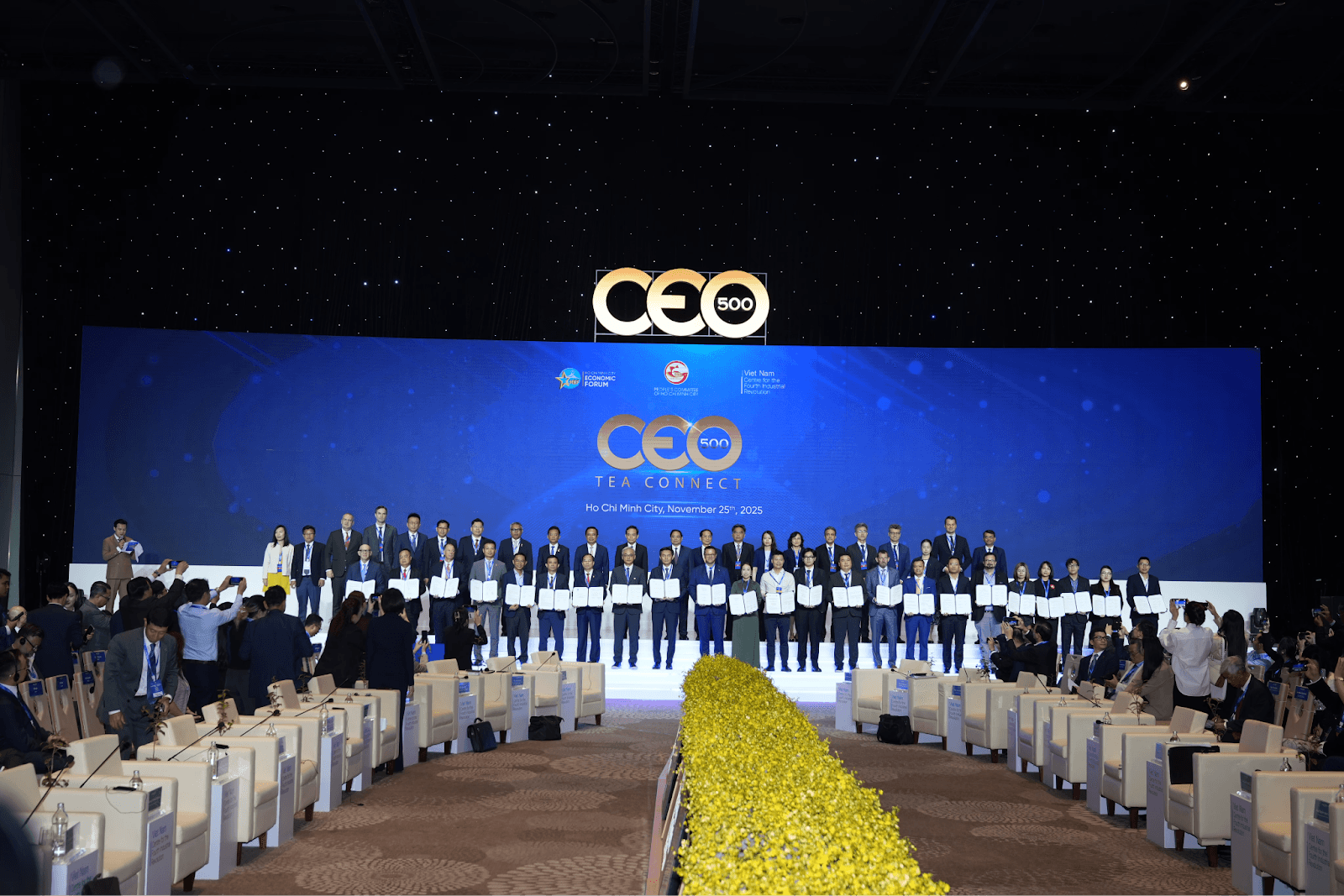
Initiatives and collaborations introduced at the CEO 500 event within the framework of the Autumn Economic Forum at Ho Chi Minh City.
As the world shifts from “physical finance” to “finance operating on digital infrastructure,” the value of a financial centre is no longer defined by the number of banks or office towers it hosts, but by its ability to lead new financial models built on data, technology, and transparency. Ho Chi Minh City understands that to compete globally, IFC-HCM must develop a new strategic advantage. And that advantage lies not in traditional finance, but in the on-chain ecosystem—where finance, technology, and innovation converge, and where emerging markets take shape before becoming global trends.
More broadly, Vietnam is facing a rare moment of opportunity. When General Secretary To Lam emphasized the need to bring digital assets into a formal regulatory framework, it sent a clear message: digital finance is no longer optional—it is essential for safeguarding economic security and unlocking new-era resources. At the same time, Ho Chi Minh City has identified “talent – technology – new governance models” as the pillars that will determine whether IFC-HCM can function as a true international financial centre. The intersection of these two policy layers makes the GOE Alliance an exceptionally important structure that enables national strategy to be implemented faster and more effectively.
“What makes the GOE Alliance distinctive is not just the list of founding members—Viettel, Dragon Capital, Tether, Ava Labs, Republic, Sky Mavis, and On-Chain Academy—but its design as an “open economic laboratory” within IFC-HCM.”
From a global competition lens, leading financial centres are racing to advance on-chain finance. Singapore launched Project Guardian to tokenize assets; Dubai established VARA to regulate digital assets; the UK integrated blockchain into its national sandbox. All share a common goal: to build competitive advantage through next-generation financial technology infrastructure. For IFC-HCM to claim its own position, it cannot enter overcrowded areas—it must choose a domain that the world is shaping but where no global leader yet exists. On-chain is precisely that strategic domain.
In this open laboratory, technology companies, financial institutions, regulators, startups, and universities can jointly experiment with new financial models—from real estate tokenization and carbon-credit tokenization to real-time cross-border payment systems. This is the model that next-generation financial centres are moving toward, because whoever controls on-chain infrastructure and operational standards will own the markets of the future.
The strategic value of the GOE Alliance for IFC-HCM goes far beyond technology. It lies in its ability to reshape markets. Once assets, data, and transactions move onto on-chain infrastructure, transparency increases exponentially, costs drop sharply, cross-border transactions settle instantly, and risks are managed through automated mechanisms. IFC-HCM therefore not only attracts new capital flows but becomes a “transit hub” for next-generation financial models—something traditional financial models cannot provide.
Another critical contribution of the GOE Alliance is talent development. By training and deploying professionals who work directly with real on-chain systems—exposed to global standards and real market pressures—it creates a generation of financial-technology-data specialists who can compete globally. For any international financial centre, this is among the most valuable assets.
Fundamentally, the GOE Alliance does more than help IFC-HCM keep up with global trends—it enables Vietnam to help shape them. In digital finance, those who set standards determine their global position. Once IFC-HCM can create, test, and standardize on-chain financial models, Vietnam will not only participate in the game but will help define its rules.
Seen from that perspective, the GOE Alliance is the “acceleration engine” propelling IFC-HCM into the era of borderless finance—an engine powered by technology, expertise, international standards, and the ambition for Vietnam to become a creator—not just a consumer—of the financial models of the future.
Assoc. Prof. Nguyen Huu Huan