Setting Southeast Asia's First Milestone: Activating a Compliant On-chain Corridor Between Vietnam and Indonesia, Covering 380 Million People — Over Half of ASEAN, with VIFC-HCMC at the Center

The On-chain Finance Network (OFN) initiative, launched by GOE Alliance, has for the first time demonstrated the technical feasibility of executing a compliant cross-border on-chain transaction between two KYC-verified citizens from two sovereign nations — without transferring raw personal data outside either country's territory. This marks a significant milestone in Vietnam's journey toward becoming the region's digital asset hub.
On April 14, 2026, at the Vietnam International Financial Center in Ho Chi Minh City (VIFC-HCMC) Building in Ho Chi Minh City, during the Vietnam Fintech & RegTech Immersion Program 2026 co-organized by Austrade and VIFC-HCMC, GOE Alliance officially unveiled the On-chain Finance Network (OFN) — a technology infrastructure layer enabling compliant digital asset transactions to occur seamlessly across sovereign jurisdictions.
For the first time in Southeast Asia, a cross-border on-chain transaction was successfully executed between KYC-verified citizens of Vietnam and Indonesia, without transferring raw personal data outside their respective national territories.

Demonstration of OFN's operation showing the KYC process for citizens of both countries at the event
GOE Alliance as Ecosystem Architect for VIFC
GOE Alliance's defining role in OFN is that of ecosystem architect — not a technology vendor, not an operator, but the coordinator of the overall technical-legal framework, connecting four parties' complementary capabilities while ensuring alignment with VIFC-HCMC's policy environment.
To formalize this commitment, GOE Alliance, Sky Mavis, PILA Corp., and TOTM Technologies signed a Memorandum of Understanding on cross-border compliant on-chain transaction infrastructure cooperation. Each party represents a strategically irreplaceable capability block. GOE Alliance provides policy coordination and global compliance framework architecture. Sky Mavis — creator of the Ronin blockchain and the Axie Infinity ecosystem with millions of global users — contributes high-quality, battle-tested blockchain infrastructure. PILA Corp., a member of Vietnam's National Data Association and architect of NDAChain, the national blockchain platform, provides the full identity verification layer for the Vietnamese side. TOTM Technologies, listed on the Singapore Stock Exchange, contributes a multimodal biometric identification system deeply integrated into Indonesia's national ID infrastructure, ensuring state-level authentication for the Indonesian side.
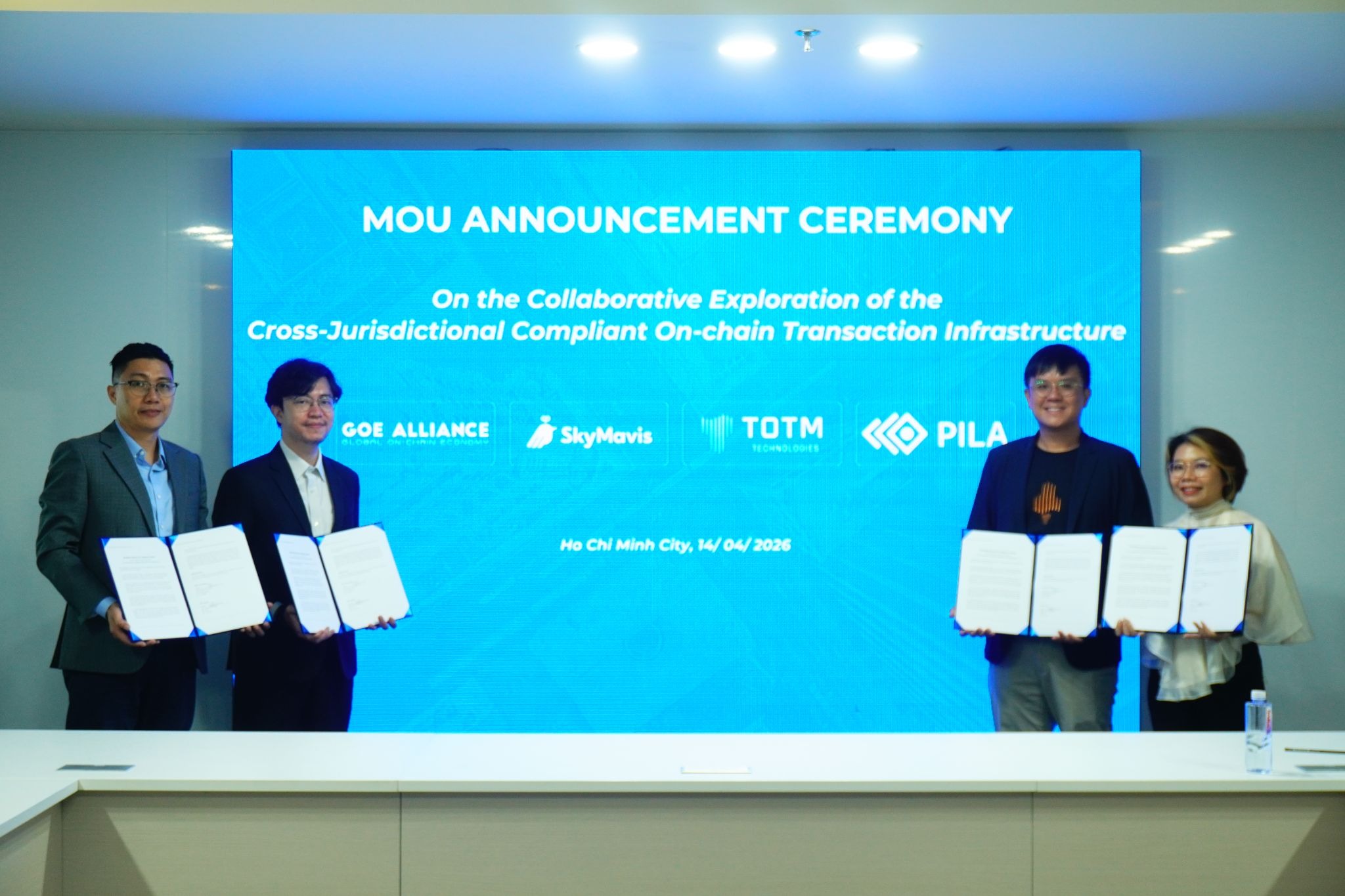
Announcement of the four-party MOU between GOE Alliance, Sky Mavis, TOTM Technologies, and PILA
This is not an ad hoc combination but a four-pillar architecture in which each party plays an irreplaceable role, designed for controlled expansion in subsequent phases of OFN.
"What we demonstrated today is not a pilot program or a whitepaper. It is a working proof that the compliance layer for a cross-border on-chain economy can be built — and that Vietnam, through VIFC-HCMC, is the right place to build it. OFN, once fully realized, could become the infrastructure backbone for on-chain capital flows across Southeast Asia and beyond." PhD. Tony Tran, Executive Board, R&D Director of GOE Alliance
"Verified credentials establish digital trust and serve as the foundation of business transactions. Complemented with aligned multi-national policy frameworks, real- time, low cost, efficient settlement layer and decentralised trust anchoring, privacy-preserving infrastructure, OFN presents opportunities for empowering trade and unlocking cross border digital product distribution across economies." Chan Wei Jie, Head of TOTM Labs
“This proof of concept demonstrates that NDAChain is not only built to meet international standards, but also capable of cross-border interoperability in practice. It proves that Vietnam is not just adopting global technology trends, but can also master and contribute core trust infrastructure for the next generation of the digital economy. We welcome more international partners to join us in exploring and advancing compliant cross-border on-chain use cases.” Nguyen Phu Dung, CEO of PILA
From the Vietnam–Indonesia Corridor to a Pan-ASEAN Compliant Connectivity Infrastructure
Phase one of OFN connects Vietnam and Indonesia — two economies with a combined population of approximately 380 million and bilateral trade reaching a record $17.2 billion in 2025. Yet the majority of this capital flow still moves through traditional correspondent banking chains costing up to 6% per transaction and taking several days to settle.
OFN addresses this directly. When a Vietnamese individual or business completes KYC/KYB verification under domestic law, that verification is converted into a privacy-preserving digital credential that can be recognized and trusted by the Indonesian side — without repeating the entire process. Compliance costs are incurred once. Both regulators retain full supervisory capacity.
Looking further ahead, as ASEAN expands — with a combined population of over 680 million and a digital economy projected to reach $1 trillion by 2030 — OFN has the potential to become the compliant connectivity infrastructure layer for the entire region's digital trade corridors.
The Spirit of Resolution 57: From Policy Direction to Technological Reality
Politburo Resolution 57-NQ/TW dated December 22, 2024 sets a strategic imperative: Vietnam must "break through" in science, technology, innovation, and digital transformation as a top national priority, with digital financial technology and blockchain infrastructure identified as priority directions.
OFN is the most concrete expression of that imperative. Rather than passively receiving digital financial standards from established financial centers, Vietnam — through VIFC-HCMC and domestic technology partners PILA Corp. and Sky Mavis alongside international partner TOTM Technologies — is actively building a new infrastructure layer without complete precedent globally: a cross-border compliance connectivity layer for the on-chain economy.
Beyond technological innovation, OFN operationalizes Vietnam's National Strategy for Digital Economy and Digital Society Development to 2025, with a 2030 outlook, under which Vietnam's digital economy is projected to reach $90–200 billion at a CAGR of 19%.
VIFC-HCMC: The Pioneer Legal Environment Behind the Milestone
OFN could hardly have emerged in a more fitting environment. Established under National Assembly Resolution 222/2025/QH15 and formally operationalized in February 2026 through Decrees 323–330/2025/ND-CP, VIFC-HCMC provides a specialized regulatory sandbox for blockchain and digital assets with pilot mechanisms that go beyond existing national legislation.
This is exactly what a defining infrastructure initiative like OFN requires: a legal space flexible enough to experiment, rigorous enough to ensure compliance, and credible enough to attract international partners. VIFC-HCMC delivers all three simultaneously.
The fact that OFN originated at VIFC-HCMC rather than Singapore, Dubai, or Hong Kong is a clear strategic signal: Ho Chi Minh City is positioning itself not merely as an adopter of digital financial technology, but as a shaper of infrastructure standards for the entire region.
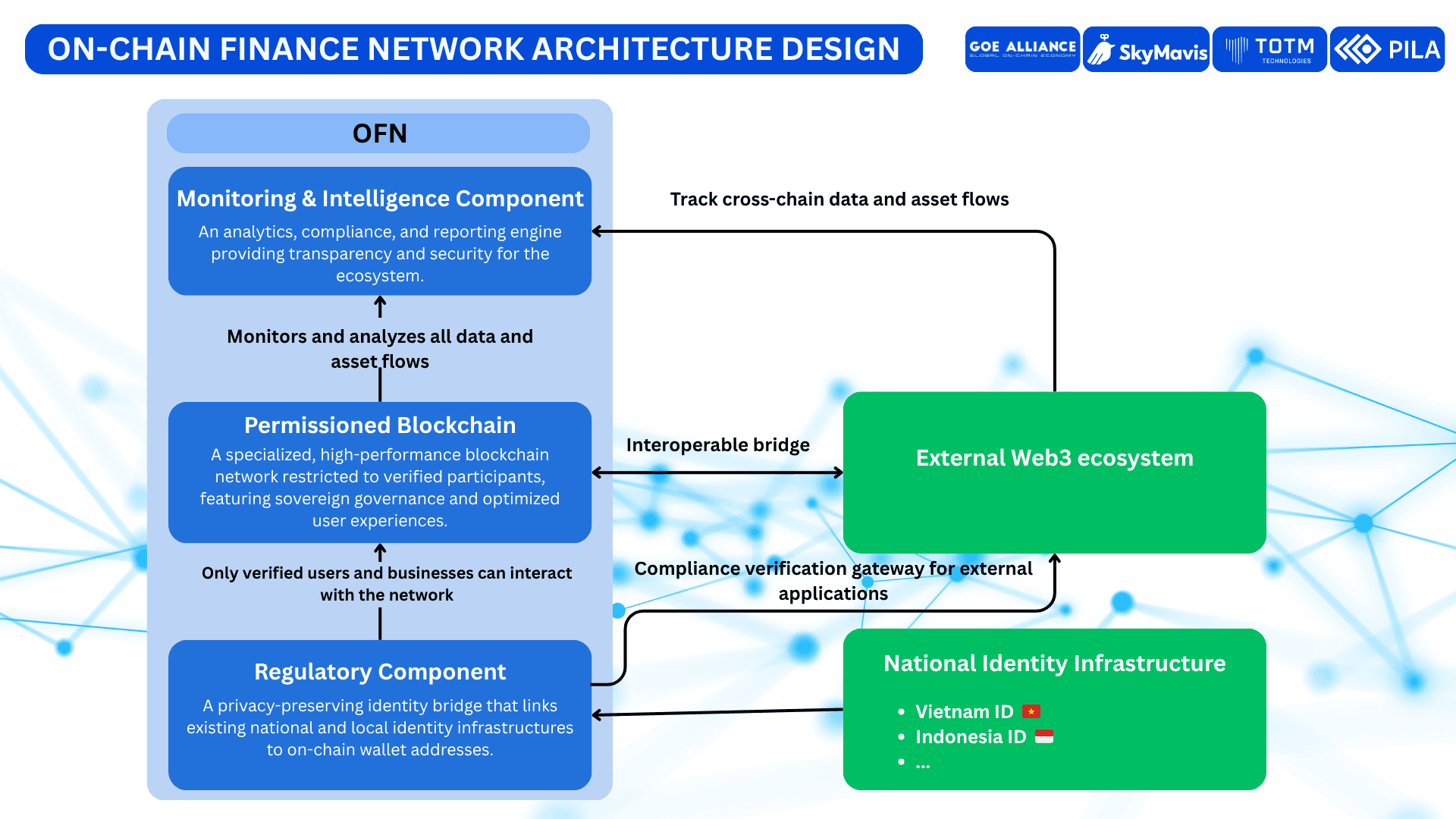
Proposed technology infrastructure design of OFN
Network Effects: The More Countries, the Stronger OFN Becomes
OFN's defining characteristic is its self-amplifying network architecture. Each new country that joins with a digital asset law or equivalent regulatory framework does not simply add one new member — it multiplies the total number of activatable transaction corridors for all existing members. This is the same network effect mechanism that made SWIFT the backbone of global finance, and it will be even more powerful with blockchain's inherent advantages: transparency, low cost, and programmability.
The global context is converging favorably: the BIS, WEF, and institutional tokenization programs such as MAS Singapore's Project Guardian all project that by 2030, up to 10% of global GDP — approximately $16 trillion — will be tokenized and operating on-chain. The wave of digital asset legislation in the US, EU, Japan, and across Southeast Asia is creating new markets ready to be connected. That is precisely the problem OFN is solving.
The Road Ahead
OFN remains at the stage of technical exploration and is not yet a fully operational network. Nevertheless, the technical feasibility of the concept has been validated in practice. Subsequent phases will include operational infrastructure refinement, compliance standard-setting, and expansion to new national corridors.
For Vietnam, the significance of this initiative extends beyond a technology project. As global digital asset markets accelerate their legislative processes, the need for compliant on-chain infrastructure to connect the region's digital economies is no longer a vision — it is a structural requirement. OFN, once deployed across borders, will position Vietnam clearly at the frontier of the global digital asset map: for the first time, we are not merely participating in a technology game — we are defining its rules.


